

Teach.
The highest-paid AI skill isn’t technical (and you already have it).

The people quietly making money with AI are not who you think.
Not the app builders. Not the automation sellers. Not the twenty-two-year-olds shipping a startup a week.
Watch it here:
They’re teachers.
See, I’ve been in tech for 20 years. I currently lead multiple programs developing AI models at Google, and I’m building a one-person business on the side, out in the open. So people ask me some version of the same question every week: “I keep hearing I should do something with AI. But I can’t code. What do I actually do?”
This article is my full answer. It has four parts, one honest number the “make money with AI” genre never shows you, and a 30-minute exercise at the end that tells you exactly what your teaching business would be built on.
Save this one and come back to it this weekend.
Send it to the smartest person you know who thinks AI passed them by.
[Subscribe]
Your experience just got a raise. (Part 1)
Here is the fear that keeps experienced people on the sidelines: AI made everything I know worthless. If a chatbot answers any question in my field in four seconds, why would anyone pay me?
Fair question. Wrong conclusion.
A few months ago, a former colleague emailed me. Project manager, fifteen years in. One question: “Which AI workflow should I start with?” She was drowning. Dozens of tools, endless tutorials, completely frozen.
My first instinct? Paste her email into a chatbot and send back whatever it gave me.
I tried it. What came back was clean, accurate, and useless. Eight reasonable options, zero decisions. It read like a brochure.
So I deleted it and answered her myself. Ignore it all. Start with this one tool, for this reason. Then the two mistakes that would actually cost her, because I’d watched people make both, over and over. Fifteen minutes of typing.
Her reply the next morning: “I’ve read a dozen articles on this. You’re the first person who told me what to skip.”
That is the whole economy in one email. The chatbot has all the information. So does everyone else now. What it cannot do is tell you what applies to you, what order matters, and what to ignore. That judgment only comes from years of doing the work.
Information is free now. Judgment is the only thing left worth paying for.
The Teaching Loop. (Part 2)
What it is (in 10 words):
One skill doing the work of four departments.
Why it matters:
Experience on its own is a hobby with a long resume. To become a business, it needs a container. And most people picture that container as a pile of skills they don’t have (marketing systems, ad accounts, sales calls), which is exactly why they never start.
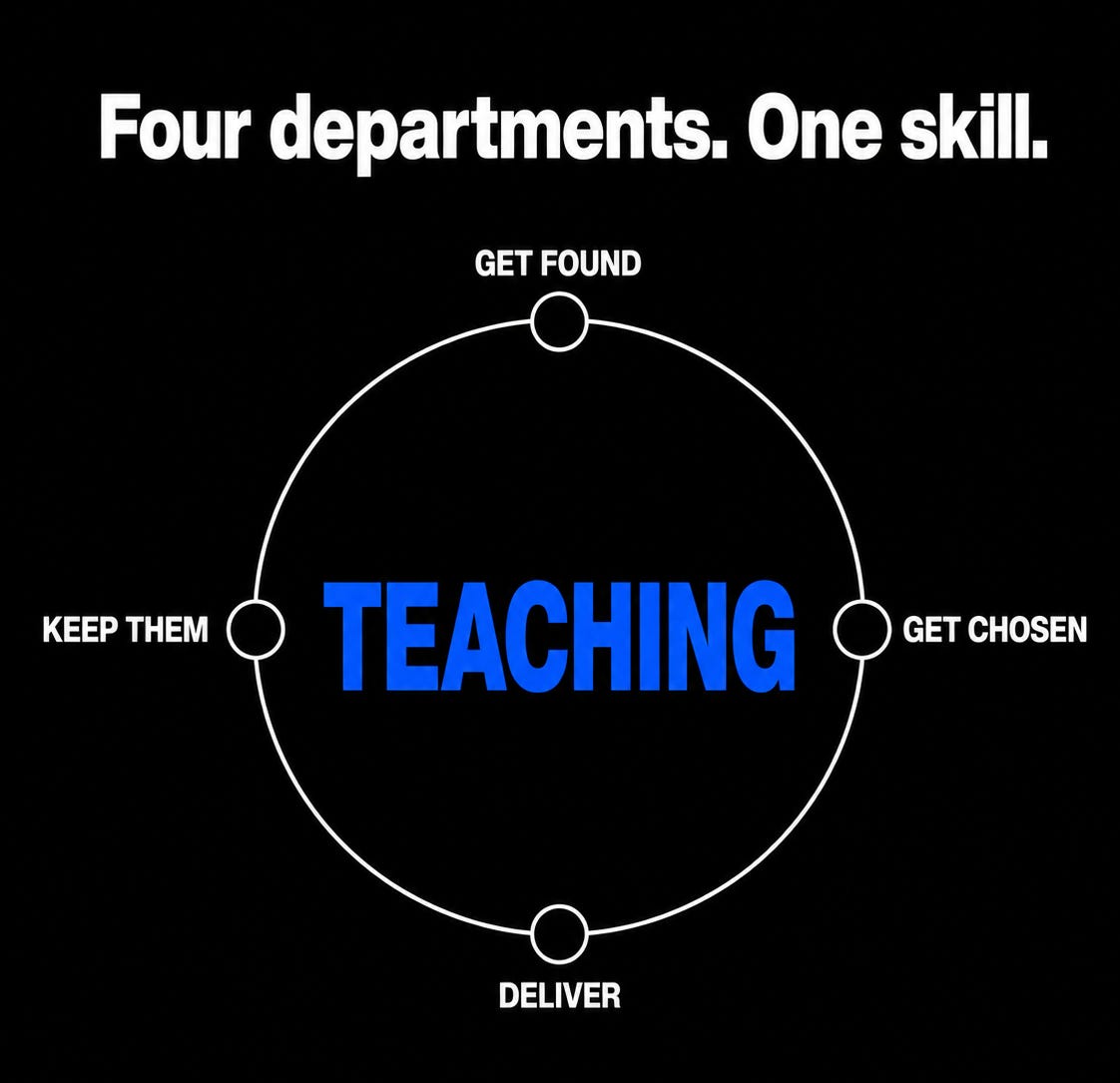
The real container is simpler. Every business has the same four parts. It has to get found, get chosen, deliver the work, and keep people around. A big company hires four departments for that.
A teaching business does all four with one skill:
Your teaching brings people in.
Your teaching earns their trust.
Your teaching is the thing they pay for.
Your teaching keeps them coming back.
What it looks like in real life:
Take a product manager with ten years of shipping software behind her. She posts about why people trying to break into product keep getting rejected. That’s how they find her. She runs a free workshop on the part of the PM interview everyone fumbles. That’s how they trust her. Her paid program walks people into their first product role. Same teaching, aimed at their exact situation.
Notice what’s missing: cold calls, a pitch deck, a sales personality she’d have to fake. Every lesson is a free sample of what working with her feels like.
[Subscribe]
The mistake that kills it. (Part 3)
The biggest mistake people make when they start teaching is teaching too much. And it comes from getting the objective wrong.
Most people think the objective is to transfer as much information as possible. That is actually a selfish way to teach. If someone is thirsty and needs a glass of water, and you come at them with a fire hose, you didn’t serve them. You overwhelmed them.
And an overwhelmed person never takes action.
The goal of teaching isn’t to get people information. It’s to create the feeling in them to take the next step. People do things for one reason only: they feel like it. You change their beliefs by making them feel it’s possible, and easy, and that they can trust you.
(Remember my colleague. What helped her wasn’t more options. It was permission to skip 38 of the 40 tools.)
The wall came down. (Part 4)
For any of this to matter, one thing had to change. And 18 months ago, it did.
What kept you out of teaching was never the knowing. It was the production. The filming, the editing, the course materials, the landing page, the email setup, the place to take payment. Putting one paid workshop online meant hiring an editor, a designer, and someone to run the marketing.
Today, one AI workspace handles most of it. You edit video by deleting sentences in a transcript. The landing page, the slides, the checkout: each one is an afternoon now, not a hire. People run the entire stack for a couple hundred dollars a month.
The wall that protected the polished marketers came down. And it let the practitioners in.
Now, the honest number (I promised):
When Udemy filed to go public, their own paperwork put the average instructor’s earnings around $3,000. Not a month. A year.
Read that wrong and you close the tab. Read it right and it’s the best news in this article. That average is low because most people on those platforms upload information: recorded lectures, generic frameworks, the exact thing AI just made free. The people actually making a living sell judgment, aimed at one specific person’s problem.
The market is crowded with information and starving for judgment. That’s your opening. It sits exactly where you’re already strongest.
Two more numbers, then the exercise. Almost two-thirds of one-person businesses are run by people over 45. And last year, 5.6 million Americans cleared six figures working for themselves, nearly double the 2020 number. You would not be early to a fringe experiment. You’d be joining the majority, with an asset most of them don’t have.
Your first 30 minutes.
Book 30 minutes with yourself this weekend. Here’s the whole session.
Minutes 0-10: Find the question.
→ Write down the last five things people asked you for help with. Coworkers, friends, the Sunday phone calls. → Circle the one that keeps repeating. That question is the seed of your curriculum.
Minutes 10-25: Answer it once, in public quality.
→ Open a doc (or Claude, and let it interview you):
I teach [YOUR FIELD]. The question people keep asking me is [THE QUESTION].

Interview me one question at a time until you can draft my answer in my voice.
Push me for: the 2 to 3 mistakes I see people make, what I tell people to
SKIP, and the one first step I always recommend.

Then draft it as a short post. Plain language. No jargon.
→ The skip list matters most. Telling people what to ignore is the judgment no chatbot can fake.
Minutes 25-30: Ship it.
→ Post the answer where the person who asks you already looks: LinkedIn, a niche community, your team’s Slack. → Watch what happens. The replies you get are your market research, free.
That’s it. Not a course. Not a funnel. One real question, answered with judgment, in public. The business grows out of the response.
If you want the exact steps from “what I know” to a one-person AI business you can start this weekend, I put the full blueprint together. It’s free: guneytopcu.com/blueprint
If this article moved something for you, be that person for someone else and share it.
See you in the next one.